Here’s to You, Forty-two! Jackie Robinson Day 2026.
Jackie Robinson Day 2026
Today is Jackie Robinson Day, the seventy-ninth anniversary of Robinson breaking baseball’s color barrier. For a kid like me growing up in Brooklyn in the 1950s, Jackie Robinson was THE MAN, along with Mickey Mantle, Willie Mays, and Duke Snider. Robinson retired from baseball in 1956, I first became a baseball fan in 1957, the Dodgers left Brooklyn in 1958, and I began an eight-year Little League career in 1959.
Unlike Robinson, I was never that good.
For me, It wasn’t so much that Robinson broke the color barrier, something I barely understood at the age of seven in 1958. Robinson was Brooklyn because the Dodgers were Brooklyn, and Jackie Robinson was the soul of the Brooklyn Dodgers. Even then, I was a Yankees fan, and even then I knew the Yankees had no soul.
The Westport Public Library held its second annual Jackie Robinson essay contest in honor of Jackie Robinson Day 2026, and under the prodding of my wife, Sara, I entered this year. My first draft I submitted to a college friend, a Massachusetts attorney, and a great storyteller, writer, and editor. I remember his words clearly. “This is the worst piece of c**p I’ve ever read, and though I’m not easily embarrassed by the work of others, for you I will make an exception!”
My father would often say the same thing, though Ken’s tone was far more neutral.
I feared I came in second to an eight-year-old in this year’s contest, but that wasn’t the case, and what can you do if I did get beat by a second-grader? My Dad once said to me while I was in high school at John Adams HS in Queens, a school known not for academic achievement but instead for its proximity to Aqueduct Race Track, that what was wrong with me was that I enjoyed coming in second.
You know, he was right. My father also once said … and there’s no denying he was right … that “the cole slaw at Waldbaum’s ain’t bad.”
That’s my Dad.
Today, April 15, 2026 there was a small ceremony hosted by the Westport Public Library at the Westport Senior Center that Sara and I attended, where I received a pair of nice gifts for my essay.
I had prepared a “thank you” speech that would run no more than one minute. It was to go like this.
“I want to thank the Westport Public Library for hosting this Jackie Robinson competition, the Westport Senior Center for hosting this ceremony, my wife, Sara, who urged me to enter the competition, my good friend Ken for ripping my first effort to shreds, and my nine-year-old granddaughter, Rosabelle, a Baltimore Orioles fan and currently in a Maryland softball league, who told me after I sent her a book on Jackie Robinson that she learned about Robinson in the third grade. When I learned I came in second in this competition, I said to myself, ‘It could’ve been worse. I could’ve come in third.’”
But I didn’t. Following Tom Waits definition of a gentleman – someone who knows how to play an accordion but doesn’t – I just said “thank you.”
My essay follows below.
And here’s to you, Mr. Forty Two! You still are the man!
Dear Mr. Robinson:
I write to you as a Westport resident, a guy who grew up in Brooklyn in the 1950s, a lifelong baseball fan, and a student of American history. Mr. Robinson, before I shuffle off to Buffalo, I have a question for you about your life and your career, on and off the field.
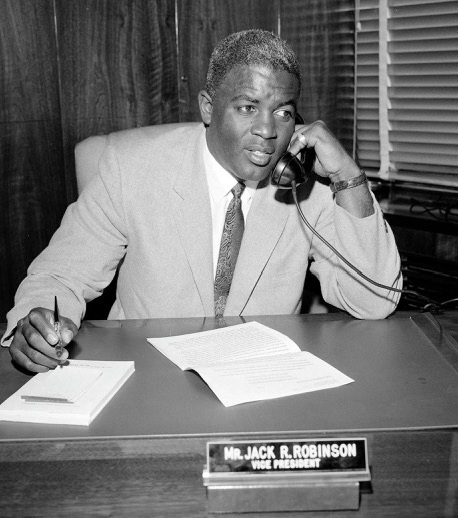
Let me frame my question for you. In 1968 I was a freshman at Brooklyn College and would walk off campus between classes to a nearby Chock Full o’Nuts store, with its serpentine sit-down counters, good coffee, and a staff of Black women wearing Chock Full o’Nuts uniforms. On the shop walls were large black-and-white photographs of other Chock Full o’Nuts shops in New York, and I recall that there was a large photo of you at work at the Chock Full o’Nuts offices on Lexington Avenue wearing a suit, seated behind a desk, with a phone in one hand and a pen signing papers in the other.
At that time, I was 17, and I knew all about your baseball career, your Civil Rights work for fair employment alongside Dr. Martin Luther King Jr. and your management position at Chock Full o’Nuts, a major New York coffee company that had a chain of coffee shops all over New York City. My family drank Chock Full o’Nuts at home. You were Jackie Robinson. ‘Nuff said.
Staring at your photo at that Chock Full o’Nuts shop, I wondered whether it was more important to the women working in this shop and the customers coming in that you became in 1957 the first Black Vice President of a major U.S. corporation, Chock Full o’Nuts, than your breaking the MLB color barrier in 1947. So, I ask you as a longtime admirer, what do you think? What’s more important to YOU? Your MLB career, or your work after your Dodger days were done?
Here’s some background to that question. I was born in 1951 and grew up three blocks away from where you first lived when you came to Brooklyn in 1947. I first learned about your Dodger career because my Dad would point to Ebbets Field and recite your name and the names Roy Campanella, Pee Wee Reese, Duke Snyder, and Don Newcombe, all fellow Brooklyn Dodgers, and how much the Dodgers WERE Brooklyn, as we took family drives on Flatbush Avenue to Prospect Park.
By 1958, I thought it perfectly natural that baseball players were white and Black and Caribbean and South American. Why? Because the baseball cards I collected displayed faces that were white and Black and so on and so forth. When I became a Yankees fan, I realized that the only Black Yankee in 1958 was Elston Howard, although I recall that Harry “Suitcase” Simpson was acquired by the Yanks in a mid-season trade.
In early 1959, and in second grade, my family moved to Hicksville in Nassau County, and I looked around at my new classmates and noticed there were no Jackie Robinsons, no Hank Aarons, no Ernie Banks, no Luis Aparicios, no Roberto Clementes, no Willie Mayses, and certainly no Elston Howards. All of my classmates were Mickey Mantles and Whitey Fords, and I had little hope for a midseason trade to bring in a Harry “Suitcase” Simpson.
During the Summer of 1959, my family moved again to Riverhead, in Eastern Suffolk County, where I soon started third grade. At that time, Riverhead was the end of the line for many farmworker families who traveled across the U.S. to pick crops, and in Suffolk County, cabbage and potatoes were farming mainstays and were harvested in the Fall. Most of these itinerant farm worker families were Black, and their kids went to school with me, and in the Spring, played little league baseball with me before heading west with their families.
In 1961 I discovered The Baseball Encyclopedia, a book that contained countless baseball statistics and a definitive history of baseball. From this book I learned that you, Mr. Robinson, were the first Black major leaguer, but only a little bit about the stoicism you had to publicly display on and off the field. When I learned that there were Negro Leagues before you broke baseball’s color barrier, it reminded me of an absurd parallel universe portrayed by Bizarro Superman in DC Comics.
So now it’s 2026, and I have a nine-year-old granddaughter who plays little league baseball, and much to my eternal dismay, is a Baltimore Orioles fan. She’s an avid reader, and I sent her a book on your life, and my question about your life and work came back to me.
What’s more important? Your MLB career, or your achievements afterwards? When my granddaughter’s done with your book, she and I can talk about you.
Respectfully,
Mark Rosenblatt
This is the aforementioned Ken from Massachusetts writing to observe that one need not be, as I am, a Platinum-level subscriber to Mutual of Rosenblatt to know that Mark can take liberties. In most circumstances, I am amused. However, it is another thing when I am misquoted. Mark ascribed to me, “This is the worst piece of c**p I’ve ever read . . ..”
Dear reader, I am here to assure you I do not generally, nor in this case did I, employ asterisks when I write.
Way to go Rosenblatt!
https://westportjournal.com/community/erdheim-wins-jackie-robinson-essay-contest/