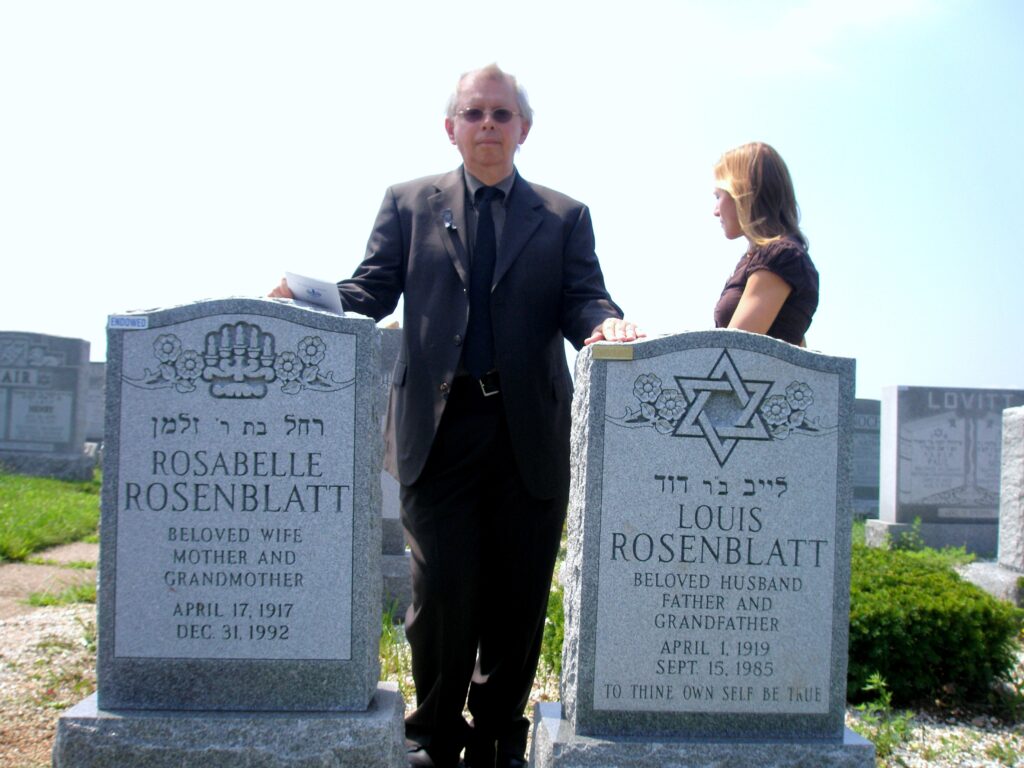
Back to Woodbridge: On the Passing of a Brother (in 2004)
My middle brother, Len, 52, died unexpectedly just before Thanksgiving, 2004. One of my brother’s friends was concerned that Len hadn’t returned his calls for four or five days, and sent police officers to check on him. They found him dead. The police called my brother’s friend, he then called my brother’s ex-wife, Laura, she then called me, and I in turn called my younger brother, Phil.
Like many middle-agers, I have some experience with death. My parents — our parents — died more than ten years ago. Consequently, I thought I was through with late-night calls. All my adult life I feared late-night calls, because late-night calls bring only bad news. When I got divorced and my ex- moved our kids some fifty miles away, a late-night call could only mean one thing: trouble. Or worse. My children are now adults, and while I care about each of them deeply, I no longer fear late night calls. Or so I thought.
While no one is ever fully prepared for the death of a parent, it is inconceivable for any child to think that his or her parents will live forever, and equally inconceivable not to consider their passing. But a younger brother? A brother one year younger than me, a brilliant, brilliant guy, a success in his career, but a brother whose world-view I never understood, and a brother with whom there were many, many brotherly issues to be resolved. And now they would never be. Unexpected deaths leave relationships frozen in time.
Much to the surprise of his two brothers, and in the last years of his life, my brother Len embraced Judaism with gusto. While each of the three brothers had some religious instruction, and each of us had a bar mitzvah, the three of us hadn’t been regular temple goers for years. I like to explain that “I’m between temples,” and had been so for forty years at the time.
Len embraced Orthodox Judaism, via the Lubavitch wing, and the Chabad organization. Chabad’s mission is to drag secular Jews, like my brothers and me, back into the fold. Len’s description of Chabad services and retreats were filled with an attractive mix of history, information, storytelling, prayer, of course, and joy. And Len often spoke of the rabbi of his Union County New Jersey Chabad group, Rabbi Levi Block. I had spoken to Rabbi Block on one or two occasions prior to Len’s death, but knew little about him prior to Len’s funeral.
Len’s ex-wife, Laura had asked Rabbi Block to coordinate graveside services for my brother, and Rabbi Block agreed. The first time I actually met him was at Beth Israel Cemetery in Woodbridge, NJ, on the Friday of Len’s burial.
Prior to the services, Rabbi Block had called to ask me to say a few words about my brother to the group of family and friends who would come to the cemetery. Rabbi Block also asked my brother Philip, Len’s ex-wife, Laura, and Len’s good friend, Andy to speak. It was a beautiful day to bury a brother, and it was truly wonderful to have a Rabbi lead a burial service who knew my brother well. At the end of the service, Rabbi Block announced that he would come to one of the shiva sittings at Laura’s home, and there hold a mourner’s service to honor my brother and acknowledge his passing.
Two days later, when Rabbi Block came to the shiva sitting, there was some initial concern that there wouldn’t be the ten Jewish men necessary to conduct a service. But Laura made some phone calls to Jewish neighbors, explained our predicament, and we were soon on our way.
After the service, I was sitting with Rabbi Block and two of Len’s friends, Andy, and his wife, Dana, who are both members of Rabbi Block’s New Jersey congregation, in the kitchen of Laura’s home.
I told Rabbi Block how great it was to hear him suggest, at the graveside service two days earlier, that it was “OK to forgive Len,” and how I was so startled by his suggestion that he had to repeat it again. “Go ahead,” he said, “It’s OK to forgive Len.” I then told the Rabbi how I got rid of fifty-three years worth of brother-to-brother issues in thirty seconds.
Rabbi Block, seated across from me, looked like he was immersed in his own thoughts. He first turned to Andy, then to Dana, and then turned back to me. A beatific smile emerged on his face. Time stopped. I can’t remember his exact words, but it was something like, “Do you know what I said?”
I had no idea what he was talking about. But then Rabbi Block said something like, “It’s funny, but you heard what you needed to hear,” and turned once again to Andy, and then to Dana, and then back to me. Rabbi Block then said, “This is truly a miracle. You heard what you needed to hear most at that moment.” He looked surprised, and he looked extraordinarily pleased.
As only someone who has been a former teacher can see, and as only someone who has taught can do, and as only someone who is aware of the dramatic impact of a life lesson headed his way, I endured Rabbi Block asking me a second time, “Do you know what I said to you?” I didn’t. I really didn’t. Instead, I saw a point, soon to be made, forming in the space directly above the kitchen table.
Don’t get me wrong here. Rabbi Block had no ulterior motive in asking me once, or even twice, “Do you know what I said?” He was as surprised at what I told him, as I was surprised at his reaction. In this instance, Rabbi Block was simply being a rabbi, teaching, and building suspense prior to the delivery of a powerful lesson in humanity. Teachers do this, but few with greater flair than Rabbi Block.
“What I told you,” Block said, “is that it’s OK to ASK Len for forgiveness.”
While Rabbi Block turned to Len’s friend, Andy, and explained the historical significance of this act of asking for forgiveness, my head went blank. How could I have misinterpreted what Rabbi Block had told me so wrong, so 180º wrong? My brother dies, and I turn the Rabbi’s words into some self-serving feel-good tripe? Didn’t I study communication theory somewhere? How often do I do this? I glanced around to see if anyone else was following this conversation I was having with myself. No such luck. I was all alone. If Len were around, he’d be doubling over cracking up.
Then Rabbi Block got around to me. He talked briefly about the tradition of asking for forgiveness in Judaism, and explained that it is a convention at funerals to ask for forgiveness of the dearly departed.
So I told Rabbi Block how stupid I felt, and how even stupider I felt for making such a big thing about me forgiving Len. In the Catholic Church, I would have had to do some form of penance, no doubt. And I would’ve thought that in Orthodox Judaism, I would be dodging lightning bolts between now and next Yom Kippur. But Rabbi Block told me that everything would be OK. All I had to do was to go back to Beth Israel Cemetery in Woodbridge, NJ, visit my brother’s gravesite, and ask Len for forgiveness.
One of my oldest and closest friends recently told me that as he grows older, he has come to appreciate cultural norms, mores, and pathways, especially in terms of grieving. At a most vulnerable time, you shouldn’t have to figure this out all alone. Not just the corralling of people and figuring out who is to bring the chopped liver, but how to grieve and reconcile as well.
So when I return to the cemetery to visit my brother, I’ll also visit other family members who are there: my Mom and Dad, my maternal grandparents, and my maternal grandfather’s second wife, who despite the fact that she cared for my grandfather, my mother could never forgive for marrying her father. I’ll talk to her, and I’ll talk to Mom. I don’t know if it’ll do any good, but I’ll talk to both of them.
And if this story sounds trite, or too self-centered, I ask you for forgiveness.
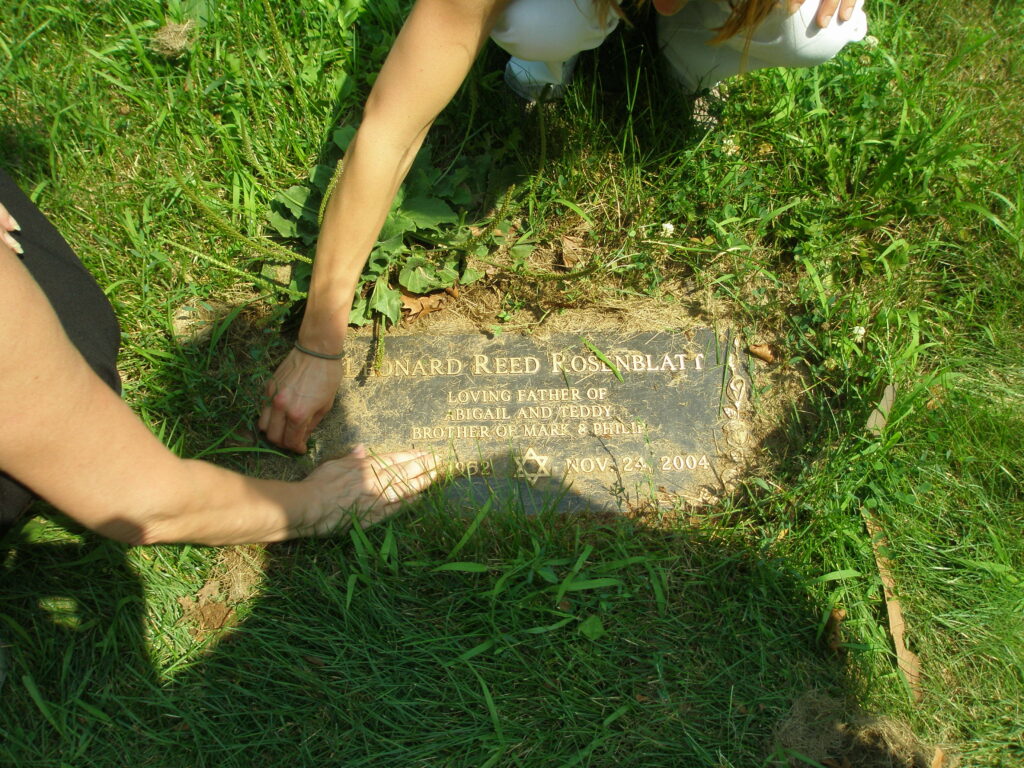
following the burial of my youngest brother Philip in 2009.